How Buffalo’s 2026 Energy Code Will Transform Your Commercial Door Requirements
Buffalo commercial properties will feel the next round of energy code changes at their doors first. Door openings are where conditioned air escapes, where wind drives infiltration, and where daily operations meet code language on accessibility, safety, and building envelope performance. Property managers across Downtown Buffalo, Elmwood Village, Allentown, Hertel Avenue, Main Street, Chippewa Street, and the Seneca-Babcock corridor should plan for tighter air leakage control, better thermal performance, smarter controls on automatic entries, and more consistent maintenance to keep assemblies within specification. The exact text that Buffalo and Erie County adopt for 2026 will finalize at enactment, but the direction is clear. It points to stricter commercial envelope requirements that align with recent IECC updates and New York State adoption cycles.
Why this matters
Buffalo sits at the east end of Lake Erie and takes some of the hardest winter weather in the country. Lake-effect storms can push snowfall totals near or above 100 inches in many seasons. Winter temperatures routinely drop below 20°F. That is the threshold where hydraulic door closer fluid thickens and loses damping consistency, which accelerates seal failure and causes doors to slam or drift. Wind at Buffalo Niagara International Airport averages around 12 mph and gusts much higher in storms, which increases pressure at door openings and drives infiltration. Road salt tracked through storefront entries corrodes thresholds and bottom pivots. Energy codes tighten because wasted energy in a climate like Buffalo has real cost. A small air gap at a pair of aluminum storefront doors on Hertel Avenue can add significant heating load across a full winter. Door assemblies are the fastest, most cost-effective place to capture energy savings without changing a building’s facade.
What the 2026 energy code likely means at your doors
Energy codes focus on measurable outcomes. For doors, that means lower air leakage, improved thermal resistance where feasible, and control strategies that minimize open time. Expect a heavier push on continuous weatherstripping at head, jambs, and meeting stiles. Expect closer settings that reduce propped-open behavior and limit hold-open time. Expect vestibules on more occupancies where traffic volume and climate exposure justify them. Expect increased scrutiny of automatic sliding and swinging door timing and sensor logic, because every extra second open leaks heat in January and chilled air in July.
This affects aluminum storefront doors, automatic sliding and swinging entries, overhead and rolling service doors at docks, and even fire-rated doors where gasket performance must align with both NFPA 80 and envelope targets. It does not mean every door needs replacement. It does mean every opening needs a plan to meet air sealing and operational control goals without compromising life safety or ADA access.
Storefront door assemblies face the most immediate changes
Buffalo retail and restaurant properties rely on aluminum storefront systems from brands such as Kawneer, Tubelite, YKK AP, Vistawall, and US Aluminum. These systems use narrow stile doors, which are 2-1/8 inches wide at the vertical member, or medium stile at 3-1/2 inches, with replaceable hardware. Most upgrades to hit energy targets can be completed through maintenance and component replacement rather than full frame swaps.
Weatherstripping, which is the continuous gasket that seals the gap between door and frame, will be the first line of compliance. EPDM bulb gaskets seal well in Buffalo winters and resist salt and UV. Door sweeps, which are the brush or rubber strips at the bottom rail, close the gap to the threshold. Aluminum thresholds can be switched to thermal-break thresholds where practical to reduce conductive heat loss at the sill. Meeting stile astragals, which are interlocking pieces between paired doors, cut infiltration at the center gap where wind enters. A clean sweep, solid head and jamb gaskets, and a true astragal solve most air leakage issues on a typical two-leaf storefront in 14202 Downtown or 14222 Elmwood Village.
Pivot hardware affects sealing as well. An offset pivot hinge, which rotates the door on a fixed pin near the bottom and a matching pin at the top rather than on side hinges, must be tight and correctly set to keep the door square to the frame. Kawneer TH1118 top and bottom pivot sets and Kawneer 050331 intermediate pivots on taller doors are common in Buffalo. Bottom pivot bearings fail faster in Buffalo because road salt and meltwater collect at the threshold. When that bearing wears, the door sags, the header gasket gaps open, and the lock no longer lines up. Energy performance drops at the same time security drops. A precise pivot replacement and door rehang solves both problems.
Hydraulic door closers are next. A hydraulic door closer is the spring and oil-filled device that controls the speed of a door as it closes. It prevents slamming and ensures latching. In cold Buffalo weather, the oil thickens below about 20°F, which reduces damping and spikes internal seal stress. Many properties run LCN 4040 or 4110 series surface closers, Norton 1600 and 8000 series, Dorma RTS88 concealed overhead closers, or Sargent 281 and 351 series. Cold-stiffened fluid will cause slow swing, then an abrupt latch, or it will leak entirely. Energy codes will drive closer settings that close promptly and latch without bounce while keeping door forces within ADA guidance. ADA interior door force guidance is 5 lbf where applicable, and exterior openings must be practical for real weather while honoring IBC Chapter 10 means of egress. The code path is to set correct sweep speed, latch speed, and backcheck on a closer suited to Buffalo winters. Where a closer is undersized or failing, replacement is the correct move.
Automatic sliding and swinging doors under tighter control logic
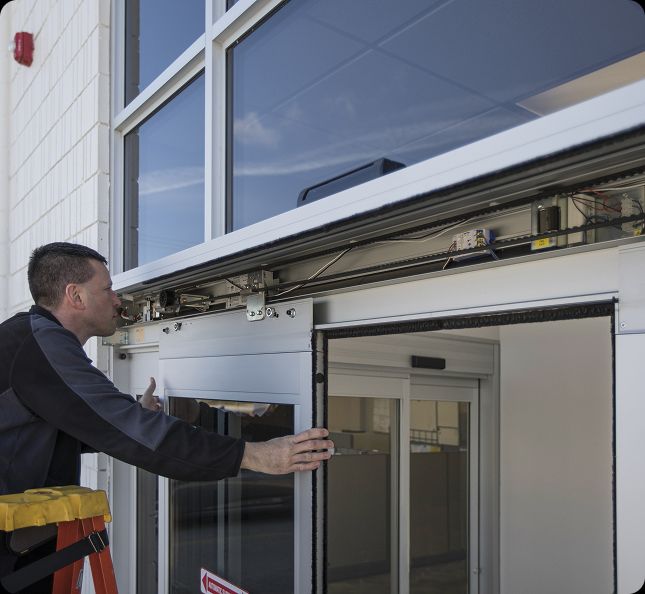
Automatic doors open hands-free. That is good for accessibility and throughput, but it is also a path for heat loss if the system holds open longer than needed. Expect the 2026 cycle to emphasize precise sensor setups and shorter default hold-open times consistent with traffic patterns. Automatic sliding doors fall under ANSI A156.10, which is the safety standard that governs motion sensors, presence detection, and timing for sliding doors. Automatic swinging doors fall under ANSI A156.19, which sets rules for low-energy and power-assist swing operators. AAADM, which is the American Association of Automatic Door Manufacturers, certifies technicians to inspect and service these systems against the standards.
Buffalo properties commonly run Record USA, Stanley, Besam ASSA ABLOY, or Horton Automatics. Record USA has strong penetration in medical office and higher-traffic retail. A door operator that holds open for ten seconds after every person wastes energy in January. A door that closes too fast trips ADA concerns. The balance is a sensor and timing package that opens quickly, stays open only as long as needed for safe passage, and closes smoothly. That balance must be verified during AAADM inspection. For operators at entries on Main Street, Elmwood Avenue, and the Buffalo Niagara Medical Campus, that calibration makes a measurable difference in energy use.
Automatic sliding door repair and preventive service become part of the energy plan. Belt tension, motor condition, and BEA or Optex sensor alignment must be correct to read actual traffic and not phantom signals from wind-driven debris at the 14203 Medical Corridor or the waterfront near Canalside. On swinging operators, door force, presence sensors at the push side, and hold-open logic need review. These are not cosmetic adjustments. They change how long conditioned air spills through the doorway in real Buffalo wind.
Glass and thermal performance where it counts
Glazing is the largest surface area at most entries. That is where low-E insulated glass delivers gains under tougher codes. Tempered glass per ASTM C1048 is standard for safety at doors and sidelites. Laminated safety glass per ASTM C1172 adds security and can help with sound control at noisy corridors. Insulated glass units, or IGUs, per ASTM E2190 combine two or more glass panes with a sealed air or gas space. A common build is a 1 inch unit with a low-E coating and argon fill. That configuration cuts conduction and radiation losses compared to single pane tempered glass. For historic storefronts on Allen Street or Grant Street where frame replacement is off the table, IGU retrofits in existing stops often meet the target without changing the street view.
In Buffalo’s climate, the return on IGU upgrades is strongest at entries with long hours and big traffic counts. Retail on Chippewa Street or at Transit Road plazas sees thousands of daily cycles. Those doors spend more time open and more time leaking around the edges. Moving from single pane to IGU with low-E is a direct cut in energy loss that stacks with better gaskets and a tuned closer.
Vestibules and wind control across Buffalo corridors
Vestibules work because they create an air lock. Wind gusts off Lake Erie hit the outer leaf, but they do not drive air directly into the heated interior. Many codes have long required vestibules for certain occupancies above a size threshold. Expect clearer enforcement and fewer exceptions. On a tight urban storefront where a built vestibule is not practical, careful weatherstripping, a fast and predictable closer, and a door policy that discourages propping can approach the same effect.
Wind on Elmwood Avenue and North Park in 14216 can push a pair of narrow stile doors inward hard on a January afternoon. If meeting stiles lack an astragal, or the top gap exceeds gasket reach, the thermal hit is immediate. A two-door vestibule absorbs the gust. Where there is no room for two doors, a center-hinged balanced door from an Ellison Bronze style system can manage wind load better than a standard pivot because the pivot is near the center of the leaf, which reduces opening force. Balanced doors are a niche, but the physics matches Buffalo wind.
Overhead and dock doors in the energy conversation
Warehouse and logistics properties in Cheektowaga, Lancaster, and along the I-90 NYS Thruway corridor leak energy at overhead doors and dock levelers. Sectional overhead doors at loading docks must seal at jambs, head, and sill. Rolling steel service doors must seat on the sill and keep side guides aligned. High-speed doors from Rytec or Albany reduce open time at busy docks, which matters during winter when the bay faces west toward the lake. Buffers and seals at dock levelers shape infiltration as trucks cycle through. These upgrades often pay back fast, because a 9 by 10 foot opening left partially open in January drains heat volume quickly.
Hormann commercial garage doors show up frequently in Erie County distribution buildings. Authorized service protects manufacturer warranties and keeps panel joints, hinge hardware, and perimeter gaskets within specification. On docks in 14225 Cheektowaga, a hydraulic dock leveler that leaks fluid will not raise to meet the trailer bed consistently, which creates a permanent gap under the dock door. A dock seal or shelter that is torn cannot seat to the trailer sides. These small failures show up on utility bills and on employee comfort complaints. An energy-focused dock audit and service plan solves them without major rebuilds.
Fire-rated and egress standards remain non-negotiable
Energy targets cannot override life safety. NFPA 80 governs fire-rated door assemblies. It requires annual inspection and documentation. The door label must remain legible. The door must self-close and self-latch. The clearance gaps must not exceed limits, typically 1/8 inch at head and jamb and a maximum undercut specification depending on floor finish. Intumescent seals, which are the strips that expand in heat to seal smoke and hot gases, must be intact. If energy upgrades remove or obstruct fire labels or interfere with self-latching, they fail inspection. For egress doors, NFPA 101 and IBC Chapter 10 set the rules. ADA door force guidance and proper panic hardware on doors with rim exit devices, such as Von Duprin 98 or 99 series or Sargent equivalents, must remain correct. Energy improvements should be documented and checked against these standards at the final punch list.
Existing building compliance paths that work in Buffalo
Most Buffalo buildings will use an existing building path that relies on targeted upgrades at door assemblies rather than gut renovation. That path puts the focus on air sealing with gaskets and sweeps, threshold replacement, closer service or replacement, and control logic on automatic entries. Visual inspection for damage, a smoke pencil test, and simple gap gauges at the meeting stile and jambs are often enough to verify improvements at entries without complex envelope testing. Where whole building testing is required by the adopted code, door leaks are common remediation targets because they are relatively easy to correct compared to masonry or curtain wall transitions.
For a high-traffic retail door pair at 14221 Williamsville, the practical sequence is remove and replace weatherstripping and sweeps, verify threshold anchorage and sealant, inspect and reset the closer for correct sweep and latch, rehang and square the door on new pivot bearings if needed, confirm Adams Rite MS1850 deadbolt or deadlatch throws cleanly into a strike that is aligned with the new gasket compression, and confirm hold-open policy is clear for staff. That process moves the needle on air leakage and security in the same visit.
Materials and brands Buffalo properties already use
Using the hardware and storefront systems already prevalent in Western New York simplifies both code and operations. Kawneer Trifab 350 through 500 series framing, Tubelite T14000 and T24000, YKK AP YES 45 XT and YES 60 XT, and legacy Vistawall and US Aluminum storefronts are common. At these frames, narrow stile aluminum doors often carry Adams Rite MS1850 deadbolts, which are mortise bolts built for narrow profiles, and Adams Rite narrow stile deadlatches for everyday traffic industrial door installation with key control. Many pairs run Von Duprin exit devices for egress. Closers are typically LCN 4040 or Norton 1600 class on surface installs, with Dorma RTS88 concealed overhead units at clean-lined entrances. Record USA automatic sliding and swinging packages show up frequently at medical and retail entries where AAADM inspection applies. These parts are all serviceable with OEM replacements backed by manufacturer warranties, which aligns with Buffalo owners who want one-trip service and durable results.
Local climate details worth planning around
Buffalo’s cool-humid Zone 5A climate with lake-effect storms creates a unique failure pattern at doors. Below 20°F, hydraulic closer fluid loses damping consistency, so doors drift or slam at the latch. That damages strikes and increases air leakage. Road salt eats aluminum thresholds and bottom pivot bearings, which drops the door and opens gaps at the head. Wind gusts across open parking fields at Walden Avenue and Transit Road drive infiltration through any gasket defect. Dense foot traffic on Elmwood Avenue, Hertel Avenue, and the Medical Corridor produces daily door cycle counts in the hundreds or even thousands, which accelerates wear beyond calmer markets. Fall pre-winter service is the highest-ROI visit in the Buffalo commercial door calendar because it fixes these predictable issues before the first hard freeze sets in.
What a practical energy-focused door scope looks like
An energy-focused scope does not need to be complex. It needs to be consistent, technically correct, and aligned to Buffalo operations. For storefronts, that means resealing, resetting, and replacing where wear has passed the point of adjustment. For automatic doors, that means AAADM-compliant sensors and timing that reduce open time without creating barriers. For docks, that means seals that meet the truck body and high-speed doors that get the opening closed quickly in winter. For fire-rated openings, that means energy measures that do not disturb labels, clearances, or self-latching.
- Replace head, jamb, and meeting stile weatherstripping with EPDM bulb gaskets sized to the frame. Install new door sweeps and confirm continuous contact at the threshold without drag that increases opening force. Reset or replace hydraulic door closers, verifying sweep speed, latch speed, and backcheck under Buffalo winter conditions. Rehang doors on new offset pivot hinge sets, including intermediate pivots on taller leaves, to square the leaf to the frame and recover gasket compression. Upgrade single panes to insulated glass units with low-E coatings where the frame accepts IGUs without altering historic sightlines.
How this impacts business door repair and installation timelines
Energy-driven scopes change priorities for business door repair. Some properties will need same-day storefront service to address air gaps ahead of winter. Others will plan phased work by corridor or by building type. For commercial door installation of new assemblies, expect submittal sets to call out specific gasket profiles, thermal-break thresholds, and IGU specifications. Expect inspectors to ask for ANSI Z97.1 safety glazing compliance and to confirm that door control forces meet ADA guidance. For automatic sliding door repair, inspectors will expect proof of AAADM inspections and timing that serves both safety and energy goals. Buffalo and Erie County permit review will look at life safety compliance within any energy improvement plan. Coordinating these items early shortens the path to final.
What this could cost in the Buffalo market
Commercial door repair and energy-focused upgrades vary by opening, brand, and condition. In general market terms, small hardware and gasket replacements often fall in the low hundreds of dollars per opening. Full hydraulic door closer replacements commonly fall in the higher hundreds per opening depending on model and mounting. Automatic operator service can range from sensor recalibration on the low end to motor and controller replacement on the higher end. Insulated glass unit replacement often runs into the thousands per opening depending on size, glazing type, and site access. Dock door sealing and high-speed door packages also scale with opening size and traffic. Every Buffalo property is different. A site walk is required for an exact estimate, particularly when code compliance and operations both drive scope.
Buffalo building archetypes and likely upgrade paths
Historic Main Street retail from Elmwood Village and Allentown to the West Side often carries aluminum storefront retrofits from the 1970s through the 1990s. These buildings usually benefit most from gasket and sweep packages, closer resets or replacements, and meeting stile astragals to cut infiltration without changing frames. Mid-century strip plazas across Cheektowaga, Amherst, West Seneca, Hamburg, and Orchard Park often run original Kawneer, Vistawall, or US Aluminum frames with narrow stile doors, which accept new weatherstripping and IGUs easily. Suburban office parks in Amherst along Main Street and Wehrle Drive often have curtain wall and storefront hybrids where automatic swing operators must meet both AAADM and tighter hold-open timing under energy goals. Big-box and mixed-use along Niagara Falls Boulevard and Maple Road respond well to IGU upgrades because large glazed areas drive cooling loads in summer. Medical facilities in the 14203 Medical Corridor use automatic sliding doors under ANSI A156.10 and demand sensor precision to balance traffic and energy through long hours.
Field realities during Buffalo winters
Field adjustments in January differ from September. A closer that behaves under warm shop settings may drift open or slam when air at the entry drops to 10°F in a lake-effect event. That is why closer adjustments during service must be tested in real Buffalo conditions at the door. Door sweeps can stiffen in cold and leave a gap if the profile is wrong. An EPDM bulb gasket that seals well in October might compress further by February when the pivot set has taken extra load from salt corrosion. Dock seals that looked intact during a dry day can show tears during a west wind storm when a trailer rocks on the bumpers. Energy targets assume stable components. In Buffalo, service technicians must set those components for winter and verify them under load.
Response model and parts that keep Buffalo upgrades on schedule
Fast compliance depends on response and parts on the truck. Stocked service trucks that carry Kawneer TH1118 pivot sets, Kawneer 050331 intermediate pivots, Tubelite and YKK AP pivot kits, Adams Rite MS1850 deadbolts and narrow stile deadlatches, LCN 4040 and 4110 closers, Norton 1600 and 8000 closers, Dorma RTS88 concealed overhead closers, Sargent 281 and 351 closers, Von Duprin 98 and 99 exit devices, EPDM weatherstripping, door sweeps, aluminum thresholds, and board-up materials shorten project timelines. Tempered glass blanks in common sizes emergency commercial door repair and insulated glass unit components for field assembly move glass repairs forward while full custom units are ordered. Automatic door service requires sensor stock, belts, and several common Record USA operator parts to fix timing and detection the same day. This one-trip model matters during tight code schedules and winter weather windows across 14204, 14202, 14203, 14222, 14225, 14228, 14150, 14221, 14075, and 14127.
How accessibility and security remain aligned with energy goals
Accessibility and security are as important as energy. ADA door force and clear width rules still apply. Panic hardware must remain free and operable. A rim exit device such as a Von Duprin 98 or a Sargent 80 series cannot bind on a new gasket. An Adams Rite 4510 paddle handle on a narrow stile door must throw the latch cleanly against a weatherstripped jamb. Electric strikes must still release on power loss consistent with life safety design. Access control card readers and electromagnetic locks must coordinate with egress and automatic operators, and their programming cannot encourage propping. Doors that keep energy inside must also keep people safe and buildings secure. Proper commercial door installation and adjustment achieve these goals together.
Local proof points decision-makers can use
Two facts shape return on door upgrades in Buffalo. First, hydraulic door closers lose damping below about 20°F. This causes erratic closing and higher failure rates in Buffalo than in milder climates, which is why fall pre-winter service is the best-timed visit of the year for entries from Downtown to Amherst. Second, busy Buffalo retail corridors like Elmwood Avenue, Hertel Avenue, and Main Street can put a storefront door through hundreds to thousands of cycles per day. That cycle load wears pivots and gaskets fast enough that a planned semi-annual service interval saves more energy and reduces repair costs compared to emergency visits. These are field realities in Buffalo, not textbook theory, and they align with the direction of tighter energy codes that care about infiltration at openings.
Why Buffalo businesses call A-24 Hour Door National Inc.
A-24 Hour Door National Inc. Is a Buffalo-based commercial door contractor at 344 Sycamore Street, Buffalo, NY 14204. The company serves all city neighborhoods and the broader Western New York corridor, including Cheektowaga, West Seneca, Hamburg, Orchard Park, East Aurora, Lackawanna, Kenmore, Tonawanda, North Tonawanda, Amherst, Williamsville, Clarence, Lancaster, Depew, and into Niagara County. Technicians handle storefront door work, automatic sliding door repair, overhead and dock doors, and commercial glass with a 24/7 emergency dispatch model. Service trucks carry common storefront pivots, closers, bearings, hydraulic fluid, weatherstripping, thresholds, and board-up materials for single-trip commercial door repair. Automatic door work is performed by AAADM-certified technicians to ANSI A156.10 and A156.19 standards, with authorized service on Record brand entrance solutions. Overhead and sectional work includes authorized service on Hormann commercial garage doors. OEM replacement parts carry manufacturer warranties, and the company stands behind its work with a satisfaction guarantee. The operation is fully insured and has more than 30 years of experience in the commercial door service market.
For properties preparing for Buffalo’s 2026 energy code cycle, the company offers preventive maintenance programs timed to Buffalo winters, storefront weatherization scopes, closer replacement and adjustment, pivot hinge repair, commercial glass replacement including insulated glass units, automatic door timing and sensor service, and dock door and leveler sealing. The team understands Buffalo corridors from 14202 Downtown and 14203 Medical Corridor to 14222 Elmwood Village and 14225 Cheektowaga, and calibrates service to lake-effect snow, wind, and salt exposure. Flexible payment options include Cash, Check, Mastercard, Visa, American Express, and Net 30 for qualified customers. The Google Business Profile currently reflects a high customer rating based on public review sources. For immediate dispatch or to schedule a code-readiness walkthrough, call (716) 894-2000 or the national line at (800) 884-4440, or visit https://a24hour.biz/buffalo/.